Which Digital Marketing Channels Deliver the Best ROI for B2B Companies?
Nov 11, 2026 — Uncategorized
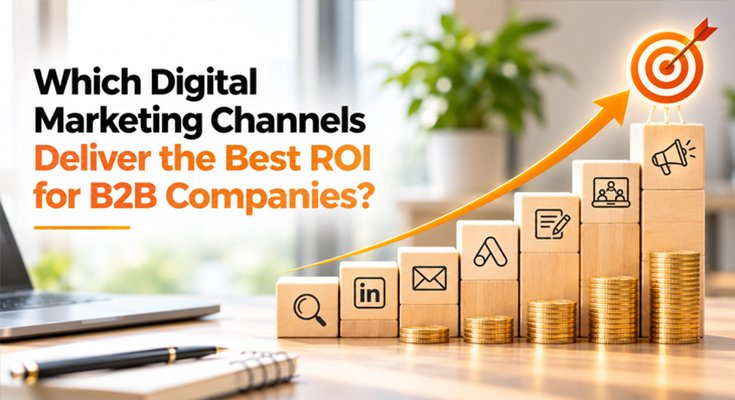
For B2B companies, digital marketing is not simply about attracting more website visitors or generating a large number of leads. The real objective is to reach the right decision-makers, build trust, generate qualified enquiries, and turn marketing investment into business revenue.
However, choosing the right marketing channels can be challenging. SEO, LinkedIn, Google Ads, email marketing, and content marketing all offer different advantages. What works well for one company may not deliver the same results for another.
The most effective approach is to understand how each channel contributes to the buying journey and select a combination that supports your business objectives.
What Does ROI Mean in B2B Digital Marketing?
Return on Investment (ROI) measures the financial return generated from a marketing investment compared with its cost.
For B2B companies, measuring ROI requires looking beyond clicks, impressions, and initial enquiries. A campaign may generate several leads but contribute very little to actual sales if those leads are not relevant to the business.
Important metrics include:
- Cost per qualified lead
- Customer acquisition cost
- Lead-to-customer conversion rate
- Sales pipeline generated
- Revenue attributed to marketing
- Customer lifetime value
Since B2B sales cycles can involve multiple decision-makers and several interactions, businesses should evaluate performance over an appropriate period rather than judging a channel by its immediate results.
7 Digital Marketing Channels That Can Deliver Strong B2B ROI
1. Search Engine Optimization (SEO)
SEO helps B2B companies reach potential customers who are actively searching for products, services, or solutions.
For example, a manufacturing company may attract relevant enquiries by appearing for searches related to industrial equipment, specialised components, or bulk supply requirements.
A well-planned SEO strategy includes keyword research, useful website content, technical optimization, internal linking, and relevant service pages.
Why it can deliver ROI: SEO can generate relevant organic traffic over time without requiring businesses to pay for every website visit. Its value can build as useful pages gain search visibility.
However, SEO requires consistency, and results may take time. It is generally better suited to businesses with a long-term growth strategy than those expecting immediate enquiries.
2. LinkedIn Marketing
LinkedIn is particularly relevant to B2B marketing because it allows businesses to connect with professionals, industry leaders, decision-makers, and potential business partners.
Companies can use organic content to share industry knowledge, company updates, project insights, and professional expertise. LinkedIn advertising can also help reach specific professional audiences based on available targeting options.
Why it can deliver ROI: LinkedIn helps businesses build professional credibility and reach audiences that may be difficult to access through broader social platforms.
For better results, focus on relevant audiences and meaningful engagement rather than simply increasing follower counts.
3. Email Marketing
Email marketing helps B2B companies maintain communication with prospects who have already shown interest in their products or services.
Businesses can use email campaigns to share industry updates, educational resources, product information, case studies, and relevant offers.
Automated email sequences can also support lead nurturing by delivering information based on a prospect’s interests or stage in the buying journey.
Why it can deliver ROI: Email provides a direct communication channel for nurturing existing contacts and encouraging prospects to take the next step.
Its effectiveness depends on having a relevant contact list, useful messaging, appropriate timing, and clear calls to action. Businesses should also follow applicable email marketing and data protection requirements.
4. Google Ads and Paid Search
Google Ads allows B2B companies to reach users searching for specific services, products, and solutions.
For example, a business offering industrial automation services can target relevant search terms to reach companies actively exploring automation solutions.
Search campaigns can be useful when businesses want to capture existing demand rather than wait for organic visibility to develop.
Why it can deliver ROI: Paid search can generate enquiries relatively quickly when campaigns target relevant keywords and direct visitors to focused landing pages.
However, advertising costs can increase in competitive industries. Broad targeting, irrelevant keywords, and poorly designed landing pages can reduce campaign profitability.
5. Content Marketing
B2B purchases often involve research, comparisons, and internal discussions before a final decision is made. Content marketing helps businesses support this process.
Useful content formats include:
- Industry-focused blog articles
- Detailed case studies
- Product and service guides
- Technical explainers
- Research-based reports
- Comparison articles
Why it can deliver ROI: Helpful content answers customer questions, demonstrates expertise, supports SEO, and gives sales teams useful resources to share with prospects.
Rather than publishing frequently without a clear purpose, businesses should create content around the problems, questions, and requirements of their target audience.
6. Webinars and Online Events
Webinars allow B2B companies to explain complex topics, demonstrate solutions, and interact directly with potential customers.
For example, a software company could organise a webinar explaining how businesses can improve operational efficiency through automation.
Why it can deliver ROI: Webinars create opportunities to demonstrate expertise, address customer concerns, and identify prospects who have a genuine interest in a particular subject.
Their success depends on the relevance of the topic, audience quality, presentation, and follow-up process. Registration numbers alone are not enough to measure business impact.
7. Account-Based Marketing (ABM)
Account-Based Marketing focuses on a selected group of high-value businesses instead of targeting a broad audience.
Marketing and sales teams work together to understand the requirements of specific accounts and deliver relevant communication through channels such as LinkedIn, email, paid advertising, and personalised content.
Why it can deliver ROI: ABM helps businesses concentrate their resources on accounts that match their ideal customer profile.
It can be particularly useful for companies selling specialised products, enterprise solutions, or high-value services. However, it requires detailed planning, coordination, and a clear understanding of target accounts.
Which Channel Should Your B2B Company Prioritise?
There is no single channel that guarantees the highest ROI for every B2B company. The right choice depends on your industry, target audience, sales cycle, deal value, and marketing objectives.
Consider the following approach:
| Business objective | Channels to consider |
|---|---|
| Build long-term search visibility | SEO and content marketing |
| Reach business decision-makers | LinkedIn marketing and ABM |
| Generate enquiries from active demand | Google Ads |
| Nurture existing prospects | Email marketing |
| Demonstrate expertise | Webinars and content marketing |
| Target selected high-value accounts | Account-Based Marketing |
For many B2B businesses, combining channels can be more effective than depending on one platform. SEO can attract prospects, content can educate them, LinkedIn can build credibility, and email can help maintain communication throughout the buying process.
How to Measure and Improve B2B Marketing ROI
Choosing channels is only one part of the process. Businesses also need a reliable way to understand which activities contribute to revenue.
Start by defining clear marketing objectives and tracking the metrics that connect to them.
Use Google Analytics 4 to understand website traffic and visitor actions. Google Search Console can help monitor organic search performance. Advertising platforms provide campaign data, while a CRM can connect enquiries with sales opportunities and customer outcomes.
Review performance regularly and ask:
- Are the campaigns reaching the intended audience?
- Are enquiries relevant to the services offered?
- Which channels generate sales-qualified leads?
- How many leads progress into actual customers?
- Does the revenue justify the marketing investment?
This makes it easier to identify what is working, improve underperforming campaigns, and allocate resources more effectively.
How Can Kaizen 360 Branding Pvt. Ltd. Help?
A successful B2B digital marketing strategy requires more than running individual campaigns. It involves connecting search visibility, content, advertising, social media, and website performance with measurable business objectives.
At Kaizen 360 Branding Pvt. Ltd., businesses can explore services such as SEO, digital marketing, social media management, content creation, and website design and development.
A structured approach helps businesses identify suitable channels, reach relevant audiences, and build a digital presence aligned with their growth objectives.
Frequently Asked Questions
Which digital marketing channel has the best ROI for B2B companies?
There is no universal winner. SEO, email marketing, LinkedIn, and paid search can all deliver value depending on the business model, audience, sales cycle, and campaign objectives.
Is LinkedIn better than other social media platforms for B2B marketing?
LinkedIn is particularly relevant for professional networking and reaching business audiences. However, the most suitable platform depends on where your target customers are active and how they research potential suppliers.
Is SEO worth investing in for B2B companies?
Yes. SEO can help businesses attract prospects who are actively researching relevant solutions. It is generally a long-term investment that requires consistent optimization and useful content.
How long does it take to see ROI from B2B digital marketing?
The timeline varies by channel. Paid search may generate enquiries relatively quickly, while SEO and content marketing usually require more time to build visibility and results. B2B sales cycles can also extend the time between an initial enquiry and revenue.
How can a B2B company reduce digital marketing costs?
Focus on audience relevance, improve landing pages, monitor lead quality, refine campaign targeting, and invest in channels that contribute to qualified opportunities rather than just traffic or impressions.
Conclusion
The best digital marketing channels for B2B companies are the ones that connect marketing activity with actual business outcomes. SEO, LinkedIn, email marketing, Google Ads, content marketing, webinars, and ABM each serve different purposes within the customer journey.
Instead of choosing a channel based on popularity or short-term performance, evaluate how effectively it reaches your target audience, generates qualified opportunities, and contributes to revenue.
A well-planned combination of digital marketing channels, supported by consistent measurement and optimization, can help B2B companies build sustainable growth and make better use of their marketing investment.
At Kaizen 360 Branding Pvt. Ltd., we help businesses create impactful digital strategies through branding, SEO, ASO, PPC, web design and development, graphic design, logo design, social media marketing, content writing and marketing, and corporate videos.
Want to build a purpose driven brand that stands out in any situation? Let us help you create a strategy that delivers real value and long term growth.