What Is Semantic SEO and How Google Understands Context
Feb 10, 2026 — SEO
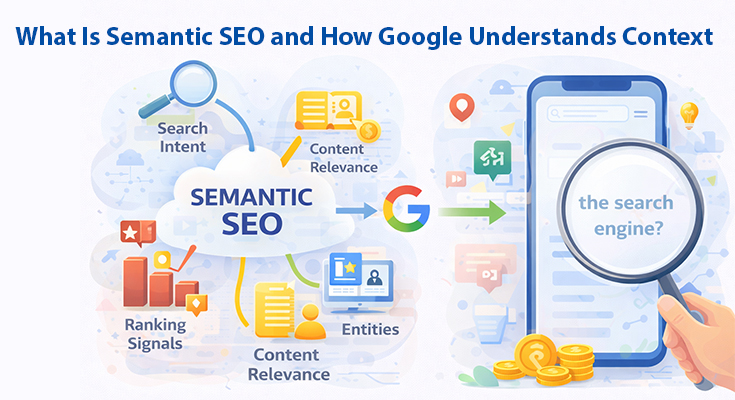
Search engines have evolved far beyond matching exact keywords. Today, Google focuses on understanding meaning, intent, and context behind every search query. This shift has made Semantic SEO one of the most important concepts for businesses investing in Search Engine Optimization in Pune and across competitive digital markets.
Semantic SEO is not about adding more keywords to a page. It is about structuring content in a way that helps Google understand what your content means, how concepts are related, and how well your page satisfies user intent.
What Is Semantic SEO?
Semantic SEO is the practice of optimizing content around topics, entities, and intent, rather than focusing solely on individual keywords. It helps search engines interpret content the way humans do by understanding relationships between words, ideas, and concepts.
Instead of optimizing only for a phrase like “SEO services”, semantic SEO ensures your content also covers related concepts such as search intent, ranking signals, user experience, content relevance, and authority.
Modern SEO services in Pune increasingly rely on semantic SEO to achieve sustainable rankings rather than short-term visibility.
How Google Understands Context in Search
Google uses advanced Natural Language Processing (NLP) systems to interpret content contextually. Rather than scanning for repeated keywords, Google analyzes how concepts are connected across a page and how well the content answers a user’s underlying question.
Google understands context through:
- Search intent analysis to determine what users actually want
- Entity recognition to identify people, brands, services, and concepts
- Content relationships to evaluate topical depth and relevance
- User engagement signals to measure satisfaction
This is why content written only for keywords struggles to perform, while well-structured, context-rich content ranks consistently.
The Role of Entities in Semantic SEO
Entities are the building blocks of how Google understands meaning. An entity can be a brand, location, service, concept, or product that Google can clearly identify and connect to other entities.
For example, when Google understands entities like:
- SEO
- Website optimization
- Content relevance
- User intent
- Digital marketing
It can place your content accurately within a broader topic ecosystem. This is a core reason why professional SEO companies in Pune now focus on entity-based optimization instead of keyword density.
Why Search Intent Is Central to Semantic SEO
Semantic SEO is deeply tied to search intent. Google aims to deliver results that best match what users are trying to achieve, not just what they type.
Semantic optimization ensures your content:
- Matches informational intent when users seek knowledge
- Supports commercial intent when users compare services
- Aligns with transactional intent when users are ready to act
This alignment improves engagement, reduces bounce rates, and strengthens long-term rankings.
How Semantic SEO Impacts Business Growth
From a business perspective, semantic SEO delivers measurable advantages:
- Broader keyword visibility without targeting each phrase individually
- Greater ranking stability during algorithm updates
- Higher-quality traffic driven by intent-based relevance
- Stronger authority positioning within your industry
Leading SEO agencies in Pune use semantic SEO to help businesses build durable organic visibility instead of chasing short-term ranking tactics.
Structuring Content for Semantic Optimization
Semantic SEO is not only about what you say, but how you structure it. Google favors content that is easy to interpret and logically organized.
Effective semantic content includes:
- Clear heading hierarchy
- Contextual internal linking
- Consistent terminology
- Comprehensive topic coverage
This structured approach helps Google connect ideas across your website and strengthens topical authority.
Semantic SEO and Long-Term Ranking Stability
Unlike keyword-focused strategies that fluctuate frequently, semantic SEO supports ranking resilience. When Google understands your content clearly, minor algorithm changes are less likely to disrupt visibility.
This is why businesses investing in Search Engine Optimization in Pune are shifting toward semantic, intent-driven strategies to protect long-term performance.
Conclusion
Semantic SEO reflects how Google truly understands content today. It prioritizes meaning, relationships, and intent over keyword repetition. For businesses seeking sustainable growth, semantic SEO is no longer optional.
Semantic SEO is about building meaning, not just rankings, and Kaizen 360 Branding Pvt. Ltd. applies this approach to help businesses achieve sustainable search visibility and authority.
Frequently Asked Questions (FAQs)
What is semantic SEO in simple terms?
Semantic SEO focuses on optimizing content for meaning and intent rather than repeating keywords.
Does semantic SEO replace traditional SEO?
No. It enhances traditional SEO by adding context, entity relevance, and intent alignment.
Do SEO companies in Pune use semantic SEO?
Yes. Modern SEO companies prioritize semantic optimization to improve ranking stability and content relevance.
Is semantic SEO important for small businesses?
Absolutely. It helps small businesses compete by ranking for broader topic relevance rather than isolated keywords.