Transforming Underperforming Websites Into Growth Assets
Dec 19, 2025 — Web Design & Development
In today’s competitive digital environment, a website is no longer just an online presence. It is a core business tool that influences brand perception, customer trust, and revenue generation. Yet, many businesses continue to operate with underperforming websites that look functional on the surface but fail to deliver measurable results.
An underperforming website is not a liability by accident. It is usually the outcome of outdated design, weak user experience, poor performance, or a lack of strategic website development. With the right approach to website design and development, these websites can be transformed into powerful growth assets.
What Makes a Website Underperform?
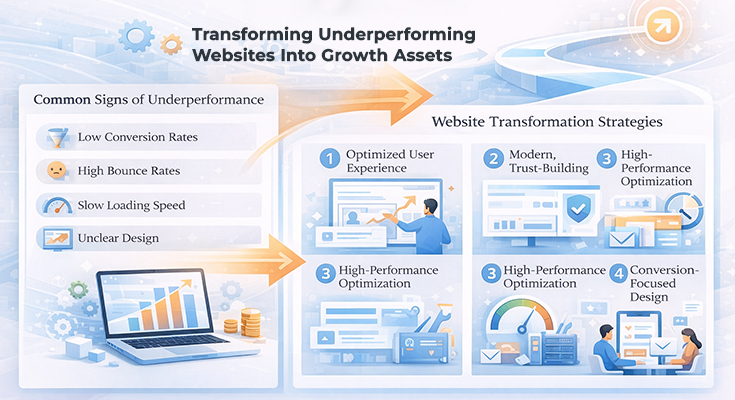
Before transformation begins, it is essential to understand why a website is not delivering results. Website underperformance is usually the outcome of several contributing issues. It is often a combination of design, development, and strategic gaps.
Common indicators include:
- Low conversion rates despite steady traffic
- High bounce rates and poor user engagement
- Slow loading speeds across devices
- Unclear navigation and weak calls to action
- Outdated visuals that reduce brand credibility
These signals indicate that the website is not aligned with modern website design and development standards or evolving user expectations.
From Online Presence to Business Asset
A growth-focused website is designed with intent. Every element supports a clear business objective, whether that is lead generation, inquiries, sales, or long-term brand authority.
Strategic website design and development shifts the website’s role from passive information display to active performance driver. This transformation focuses on three critical pillars: user experience, performance, and conversion.
Optimizing User Experience for Engagement
User experience forms the foundation of a high-performing website. Visitors should quickly understand who you are, what you offer, and what action to take next.
Improving UX involves:
- Simplifying navigation for clarity and flow
- Structuring content for easy scanning and readability
- Creating consistent layout and visual hierarchy
- Designing intuitive user journeys across pages
When user experience is prioritized during website design and development, engagement improves naturally, leading to longer sessions and better conversion opportunities.
Strengthening UI for Brand Clarity
Visual design plays a strategic role in how users perceive a business. A poorly designed interface can weaken trust, even when the service offering is strong.
Modern UI improvements focus on:
- Clean, professional layouts aligned with brand identity
- Consistent typography, spacing, and color usage
- Clear emphasis on key actions and messages
- Responsive design across all screen sizes
A well-executed UI reinforces credibility and supports usability, which is essential for conversion-focused website design services.
Performance and Speed as Growth Drivers
Website performance directly influences user behavior, SEO visibility, and conversion rates. Slow-loading websites frustrate users and reduce trust instantly.
Performance optimization includes:
- Image and asset optimization
- Clean, efficient development practices
- Improved hosting and caching strategies
- Mobile-first performance enhancements
Strong website development practices ensure that performance supports both user experience and search visibility.
Converting Traffic Into Measurable Results
Traffic alone does not drive growth. High-performing websites are designed to guide users toward meaningful actions.
Conversion-focused improvements include:
- Clear, action-oriented calls to action
- Strategic placement of forms and contact options
- Simplified inquiry and lead capture processes
- Trust-building elements such as testimonials and credentials
This is where professional website design and development transforms a website into a revenue-generating asset.
Technical Foundation and Scalability
An underperforming website often lacks a solid technical foundation. Weak structure, outdated frameworks, and limited security restrict long-term growth.
Strategic website development focuses on:
- Scalable architecture for future expansion
- Secure and regularly updated systems
- SEO-ready site structure and clean URLs
- Easy content management and maintenance
A technically sound website supports adaptability, stability, and long-term performance.
The Role of Redesign in Website Transformation
In many cases, transformation requires more than surface-level improvements. A structured website redesign aligns design, development, and business goals into a unified strategy.
Website redesign is not just about visual updates. It involves rebuilding the digital experience to improve usability, performance, conversions, and scalability. This approach is a key component of comprehensive website design and development services.
Conclusion: Turning Websites Into Growth Engines
An underperforming website does not reflect a failing business. It reflects the need for strategic digital improvement. With the right balance of user experience, visual clarity, technical performance, and conversion strategy, any website can become a growth-focused digital asset.
Businesses that invest in strategic website design and development gain more than a modern website. They gain a platform that actively supports growth, engagement, and long-term success.
A website should work as hard as your business does. Kaizen 360 Branding Pvt. Ltd. focuses on turning underperforming websites into growth assets through strategic thinking, precise execution, and long-term vision.