The Future is Branded: B2B Branding Trends for Technology Firms
The era of anonymous, purely functional B2B technology is over. In today’s market, where technology solutions are increasingly complex and competitive, the difference between a successful sale and being overlooked often hinges on one factor: brand equity.
For modern technology firms, the brand is no longer just a logo; it’s a strategic asset that communicates trust, authority, and emotional value to sophisticated buyers. These buyers, often high-level executives, engineers, and procurement teams, are looking not just for features, but for a partner that can genuinely solve their complex, high-stakes problems.
To succeed in this environment, B2B tech companies must move beyond traditional corporate marketing and embrace a new set of branding trends focused on human connection, clarity, and authenticity. As a leading branding company in Pune, Kaizen 360 Branding Pvt. Ltd. has helped technology firms adopt these trends to improve brand perception and market positioning.
Here are the key branding trends shaping the landscape for technology firms today.
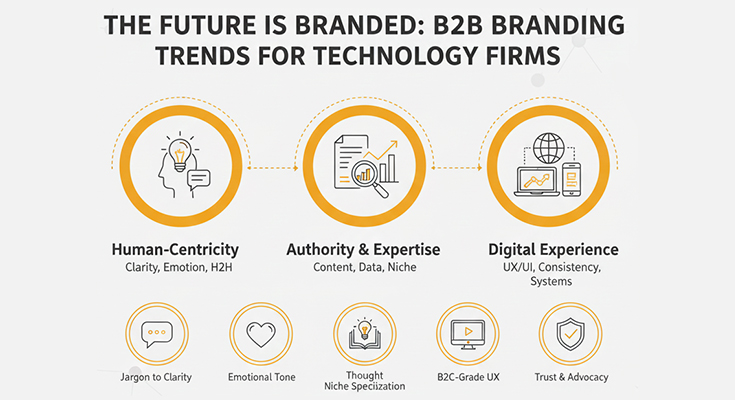
I. Human-Centricity: The Shift from Product to People
The most significant trend is the fundamental move away from sterile, feature-heavy marketing toward Human-to-Human (H2H) branding. B2B buyers are consumers too, and they expect the same emotional and simple experience they get from B2C brands.
1. From Jargon to Clarity
Technology firms have historically relied on technical jargon (speeds, feeds, acronyms) that often confuses buyers outside of the core engineering team.
- The Trend: Radical clarity and simplification. Successful brands use storytelling and plain language to explain the outcome and the impact of their technology, not just the technical specifications. The focus shifts from “our AI uses a proprietary GNN algorithm” to “We automate your supply chain decisions, saving you 30% in waste.”
- The Strategy: Use analogies, case studies, and customer testimonials that emphasize the before-and-after scenario, proving the tangible business value rather than the technical prowess.
2. Emotionalizing the Purchase
While B2B purchasing is rational, the decision-making process is fueled by fear (of failure, of obsolescence) and aspiration (of growth, of efficiency).
- The Trend: Injecting ethical and emotional tone. Brands are building connections by aligning with the buyer’s personal goals and fears. This involves showcasing the human faces behind the technology, including engineers, support staff, and happy customers.
- The Strategy: Focus on the emotions of security, confidence, and trust. A strong brand acts as a reliable partner, mitigating the risk inherent in adopting new technology.
II. Authority and Expertise: Content as the Primary Brand Driver
In B2B tech, buyers rely heavily on research. Their trust is earned by brands that consistently demonstrate superior knowledge and deep domain expertise.
3. Thought Leadership as a Product
The white paper and the dry technical blog post are no longer enough. Buyers expect proactive, future-facing insights.
- The Trend: Creating “pillar content” and proprietary data. Technology firms are investing heavily in original research, market reports, and data visualization tools that are genuinely useful to their audience. This content becomes a lead-generation tool and a powerful proof point for the brand’s authority.
- The Strategy: The content should solve the industry’s thorniest problems and predict future trends, positioning the firm not just as a vendor, but as an indispensable industry guide.
4. Niche Specialization
The age of the “jack-of-all-trades” technology company is fading. Buyers in vertical markets (FinTech, HealthTech, AgTech) demand domain-specific expertise.
- The Trend: Hyper-vertical branding. Technology brands are moving away from generic solutions to specialize their messaging for specific industries or even sub-sectors.
- The Strategy: The brand language, case studies, and sales collateral must speak fluently to the nuanced challenges of that specific vertical (e.g., using regulatory compliance language for FinTech, or efficiency metrics for logistics).
III. Digital Experience: Brand Consistency Across the Funnel
The B2B buyer’s journey is long, non-linear, and largely self-directed. The digital experience must reflect the brand’s promise at every stage.
5. Website as the Conversion Engine
The corporate website is the single most critical asset, serving as the knowledge hub, sales tool, and trust indicator.
- The Trend: B2C-grade UX/UI. B2B websites are adopting the speed, elegance, and intuitive navigation of the best consumer sites. They must be fast, mobile-responsive, and prioritize a clear, mapped user journey toward high-value conversions (demo requests, consultation calls).
- The Strategy: Integrate interactive tools, pricing transparency (where appropriate), and immediate access to technical documentation to allow sophisticated buyers to self-qualify quickly.
6. Embracing Brand Systems over Static Guidelines
Traditional brand guidelines often fail to account for dynamic digital channels (social, video, interactive tools).
- The Trend: Flexible, dynamic design systems. Tech brands are building cohesive design systems that allow for consistent application across all channels, including data dashboards, software interfaces (UX/UI), and marketing collateral. The look, feel, and voice must be unified across the website, the product itself, and all customer communications.
- The Strategy: Use unified color palettes, typography, and visual language to ensure every interaction, even within the software, reinforces the brand identity.
IV. Social Proof and Authenticity: Building Trust Faster
In a world saturated with vendor claims, social proof and genuine endorsements accelerate the purchasing decision.
7. The Power of Advocates
Case studies are now being replaced or supplemented by real-time advocacy.
- The Trend: Activating the customer community. Brands are focusing on building strong customer communities, enabling peer-to-peer validation, and featuring unscripted customer voices through video testimonials and forum participation.
- The Strategy: Focus on platform reviews and G2/Capterra ratings, as third-party validation often holds more weight than proprietary marketing claims.
8. Transparency and Sustainability
Modern corporate buyers, particularly younger generations, increasingly scrutinize the ethical stance and social responsibility of their vendors.
- The Trend: Authentic purpose-driven branding. Technology firms must genuinely commit to and communicate their stance on issues like data ethics, sustainability, and workforce diversity. This cannot be a marketing add-on; it must be reflected in the brand’s actions and policies.
- The Strategy: Use the brand to communicate clear policies on data governance and demonstrate tangible environmental or social impact, appealing to the values of their high-level stakeholders.
Conclusion: The Brand is the Business
For B2B technology firms, the brand is no longer a soft marketing concept. It is the hard-wired competitive differentiator that dictates sales cycles, valuation, and market positioning. By prioritizing human clarity, demonstrating undisputed expertise, and ensuring a unified digital experience, technology firms can evolve from being mere vendors into essential strategic partners.
Ready to leverage these modern trends to transform your technology firm’s market perception and pipeline?
Explore comprehensive digital marketing and website redesign services from Kaizen 360 Branding Pvt. Ltd., a leading branding agency in Pune and one of the most trusted advertising agencies in Pune, India.