The Digital Hurdle: 10 Common Website Mistakes Stifling Growth for Indian Businesses
Oct 07, 2025 — SEO, Web Design & Development
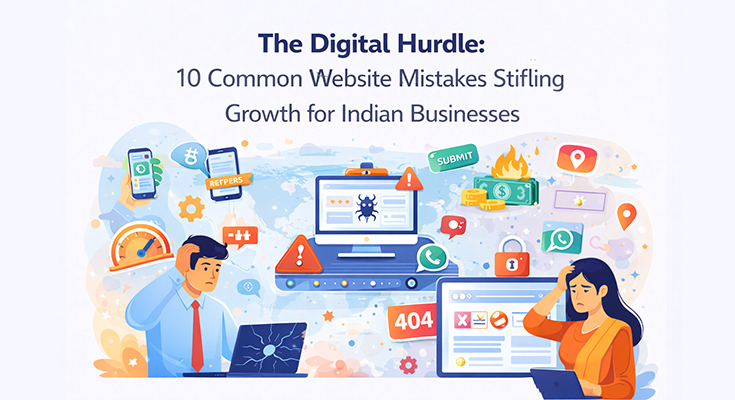
India’s digital landscape is undergoing a monumental shift. With over 800 million internet users and a mobile-first economy, the “online storefront” has become the primary point of contact between a business and its customers. From traditional family-run enterprises in Tier-2 cities to high-tech startups in Bengaluru, the urgency to have a professional website design and development presence is well-understood.
However, having a website is no longer enough. Many Indian businesses fall into the trap of building a “static brochure” website that fails to convert. Whether it’s a lack of technical optimization or a misunderstanding of the modern Indian consumer’s psychology, these digital errors are costing companies millions in lost leads and brand reputation. This is where strategic website development plays a critical role.
If you want to ensure your business doesn’t just exist online but thrives, you must avoid these 10 common website mistakes.
1. Neglecting the “Mobile-First” Reality
India is primarily a mobile-first nation. The vast majority of Indian users access the internet via smartphones, often on varying data speeds. A common mistake is designing a website on a wide desktop screen and treating the mobile version as an afterthought, instead of prioritizing mobile-first website design and development.
The Error: Buttons that are too small to tap, “pinch-to-zoom” text, and heavy desktop-only features that break on a phone.
The Impact: If your site doesn’t load or function perfectly on a mobile device, you are effectively closing your doors to 70% to 80% of your potential market.
2. Inviting “Clutter” and Distractions
There’s a frequent tendency among Indian businesses to try and say “everything at once.” This results in homepages filled with scrolling news tickers, multiple pop-up windows, flashing banners, and thick walls of text, often due to poor website design planning.
The Error: Violating the “White Space” principle. When a user is overwhelmed with information, they experience choice paralysis and leave.
The Impact: High bounce rates. A confused mind always says “no.” Your website should lead the user through a clean, logical journey toward a single action, which is a core principle of effective website design.
3. Sluggish Performance and Load Times
While 5G is expanding, a significant portion of the Indian audience still operates on fluctuating 4G or even 3G networks, especially in rural or semi-urban areas.
The Error: Using unoptimized, high-resolution images or heavy scripts that take forever to load due to weak website development practices.
The Impact: Research shows that if a site takes longer than 3 seconds to load, nearly half the visitors will abandon it. Speed is not just a luxury; it is a critical SEO ranking factor and a core part of the user experience in modern website design and development.
4. Hidden or Non-Existent Trust Signals
In the Indian market, trust is the most valuable currency. With the rise of digital scams, customers are naturally skeptical of businesses that lack transparency.
The Error: Missing physical addresses, lack of a GST number for B2B websites, no clear “About Us” page with real team photos, and the absence of verified customer testimonials, all of which should be built into professional website development.
The Impact: A website that looks like a generic template with stock photos feels anonymous and untrustworthy. Without visible social proof, conversion rates plummet.
5. The Absence of WhatsApp and Instant Connectivity
Indian consumers value direct communication. Unlike Western markets where email is the primary communication tool, India runs on WhatsApp.
The Error: Forcing users to fill out long, multi-field contact forms or providing only an “info@company.com” email address rather than enabling instant communication features as part of the website development process.
The Impact: You lose the impulse lead. A missing WhatsApp integration or Click-to-Call button means you are ignoring the preferred communication channel of your entire target audience.
6. Weak Content Strategy and Language Nuance
Many Indian businesses either use overly complex technical jargon or, conversely, have content riddled with grammatical errors and typos.
The Error: Writing for the business owner’s ego rather than the customer’s needs, and failing to align content with the overall website design and user experience.
The Impact: If the content doesn’t resonate or feels copied and pasted, the brand loses authority. Professional, localized, and benefit-driven copy is what converts visitors into customers on a well-structured website.
7. Ignoring Local SEO and Discovery
A website has little value if it cannot be discovered by potential customers. Many businesses invest in website development in Pune or other cities but ignore the geographic optimization required to show up in local Indian searches.
The Error: Not integrating the website with a Google Business Profile or failing to use location-specific keywords such as service-based searches.
The Impact: You lose out to competitors who may have a weaker business but a stronger local search presence supported by SEO-ready website design and development.
8. Poor Call-to-Action (CTA) Placement
What do you want the visitor to do? Many Indian websites fail to provide a clear answer due to poor conversion-focused website design.
The Error: Using vague CTAs like “Submit” instead of action-driven phrases.
The Impact: Even a site with great traffic will fail if the conversion math is off. A confusing CTA can keep your conversion rate near zero, regardless of traffic volume.
9. Outdated Design and “Flash” Mentalities
Some businesses are still using design aesthetics from the early 2010s, which reflects outdated website design standards.
The Error: A website that looks old signals that the business is also out of touch.
The Impact: In B2B markets, an outdated website can disqualify you from large contracts before you even get a chance to pitch.
10. Lack of Security and Basic Maintenance
Many Indian businesses launch a website and then forget it.
The Error: Allowing an HTTPS certificate to expire or ignoring security updates due to poor website maintenance practices.
The Impact: No user will enter their details on a site marked “Not Secure.” An unmaintained website is also a prime target for hacking.
Summary: The Cost of a Bad Website
Your website is often the only salesperson working for you 24/7. When it is riddled with these mistakes, it’s like having a salesperson who is slow, confusing, and unreliable.
By fixing these ten areas through professional website design and development, Indian businesses can bridge the gap between having a website and having a growth engine.
The transition from a digital liability to a digital asset requires a strategic approach involving UI/UX, technical SEO, and a deep understanding of the Indian consumer.
Stop letting an underperforming website leak potential revenue and start transforming passive visitors into high-value clients with strategic, growth-focused website redesign services from Kaizen 360 Branding Pvt. Ltd., Pune.