Should Your Website Use AI Chatbots? Pros and Cons
Aug 28, 2025 — AI, Web Design & Development
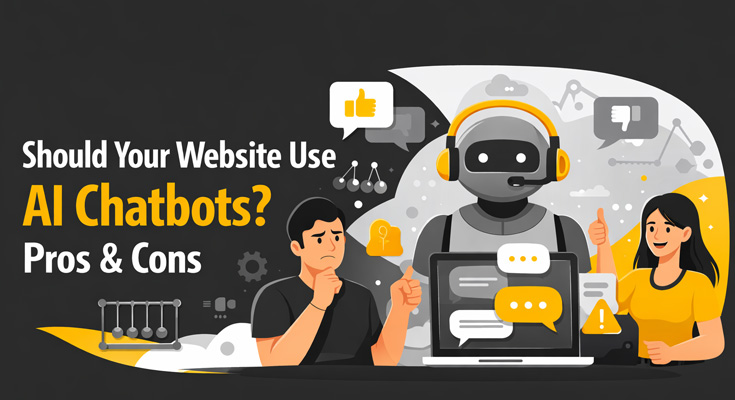
The integration of Artificial Intelligence (AI) chatbots has moved beyond novelty to become a critical component of customer service and lead generation for many modern websites. These bots, powered by natural language processing (NLP) and machine learning, offer the promise of 24/7 efficiency and personalized interactions. However, deploying an AI chatbot is a strategic decision that comes with its own set of technical, operational, and customer experience trade-offs.
Deciding whether your brand website should use an AI chatbot requires a careful weighing of the operational benefits against the potential for customer frustration.
The Pros: Why AI Chatbots Are a Digital Asset
AI chatbots, when properly implemented and trained, provide significant advantages that can boost both internal efficiency and the customer journey.
1. Instant 24/7 Availability and Response Speed
Always On: Unlike human support staff, an AI chatbot never sleeps, providing immediate assistance regardless of time zone or operational hours. This instant response is critical in a fast-paced digital environment where customers expect immediate gratification.
Reduced Wait Times: By instantly handling routine queries, chatbots eliminate hold times, significantly improving the initial customer experience and reducing customer frustration.
2. Efficient Handling of Routine Tasks
First Line Triage: Chatbots excel at answering frequently asked questions (FAQs), guiding users through navigation, resetting passwords, and checking order status. They resolve high volumes of simple, repetitive queries, freeing up human agents to focus on complex, high value, or emotional issues.
Scalability: A single chatbot can handle hundreds or even thousands of concurrent conversations, offering unparalleled scalability during peak traffic or unexpected surges in demand.
3. Data Collection and Hyper Personalization
Behavioral Insights: Every interaction with a chatbot generates valuable data on customer intent, common pain points, and preferred solutions. This data is crucial for continuous improvement of content and services.
Lead Qualification: Chatbots can be programmed to ask targeted qualification questions before seamlessly passing a high quality, pre vetted lead directly to the sales team.
Dynamic Guidance: By integrating with the Customer Data Platform, a chatbot can offer hyper personalized support by referencing a user’s past purchase history or known product preferences.
4. Cost Reduction
Lower Overhead: Automating basic customer service functions significantly reduces the need for large, round the clock support teams, leading to substantial savings in labor costs.
The Cons: Risks and Limitations of AI Chatbots
Despite their benefits, poorly deployed or over relied upon chatbots can damage the brand experience and erode customer trust.
1. Lack of Empathy and Human Touch
Emotional Disconnect: Chatbots lack genuine empathy and emotional intelligence. They struggle with sensitive issues where tone, understanding, and reassurance are necessary.
Frustration Escalation: When a chatbot fails to understand a complex query, the customer may feel ignored or misunderstood.
2. Limitations in Handling Complexity and Context
Stuck in a Loop: Chatbots are limited by their training data. They can become repetitive or fail entirely when confronted with ambiguous or highly contextual questions.
Poor Handoff: If the transition from bot to human agent is slow or requires the customer to repeat information, the brand experience suffers.
3. Training, Maintenance, and Cost of Failure
Initial Setup and Tuning: Creating an effective chatbot requires investment in high quality training data, strong NLP models, and regular updates. A bot that provides incorrect information harms the brand more than having no bot at all.
Voice and Tone Risk: The chatbot’s tone must align with the brand personality. An overly robotic or inconsistent tone can create a negative impression.
4. Data Privacy Concerns
Trust Barrier: Customers hesitate to share personal details with chatbots due to concerns about data usage, storage, or security.
Conclusion: Finding the Balance
The question is not whether your website can use an AI chatbot, but how it should use one.
The most effective approach is a balanced strategy:
Rule 1: Always provide a clear option for customers to switch to a human agent.
Rule 2: Use the chatbot mainly for FAQs, triage, and lead qualification where it delivers maximum value.
Rule 3: Use chatbot interaction data to continuously improve your website and services.
By integrating AI chatbots as a smart support layer instead of a full replacement for human interaction, your brand can enhance its digital experience. This aligns with modern practices followed by a top web design company in Pune and supports stronger results for businesses investing in website development in Pune. If you plan to enhance your digital presence with professional website development in Pune, smart features like AI chatbots can significantly elevate user experience.
If you are looking for professional web design and development, Kaizen 360 Branding Pvt. Ltd. is your trusted partner for smart and effective digital solutions.