Hyper-Personalization and Data-Driven Marketing for Brand Websites: The Next-Gen Conversion Engine
Dec 30, 2025 — Digital Marketing
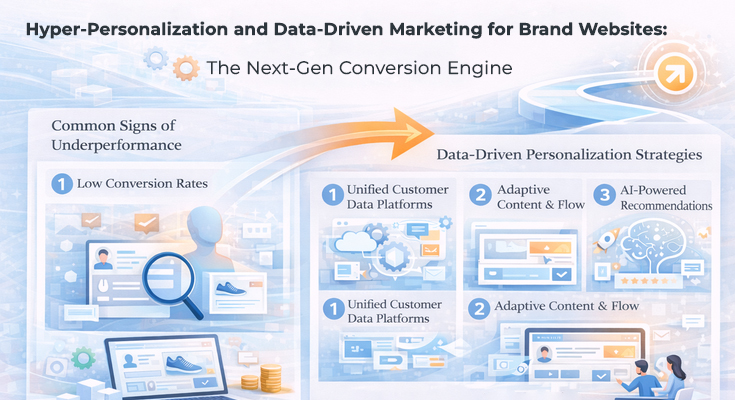
The generic brand website is fast becoming obsolete. In a digital marketing landscape defined by abundance and noise, customer attention is the most valuable currency. By 2026, simply driving traffic is not enough. The focus has shifted toward delivering highly relevant, personalized experiences that convert visitors into customers.
For businesses working with a professional digital marketing company, the brand website has become the central asset. It functions as a knowledge hub, sales platform, and conversion engine. Strategic digital marketing services now focus on transforming websites through data-driven personalization rather than static messaging.
This guide outlines how hyper-personalization and data-driven digital marketing strategy can turn brand websites into next-generation conversion engines.
I. The Data Foundation: Fueling Hyper-Personalization
Effective personalization depends on the quality of data driving it. In 2026, data must be accurate, real-time, and ethically managed to support scalable digital marketing services.
1. Unifying Customer Data Platforms (CDP)
Disconnected tools such as CRM systems, analytics platforms, and email marketing software create fragmented customer views.
Action:
Implement a unified CDP to centralize customer touchpoints including behavioral data, intent signals, and real-time session activity.
Outcome:
A complete customer profile that enables personalized digital marketing across channels, improving engagement and conversion potential.
2. Real-Time Behavioral Analysis
Hyper-personalization must respond instantly to user behavior.
Action:
Use AI and machine learning models to analyze in-session behavior such as scroll depth, hover patterns, and search interactions.
Outcome:
Websites adapt in real time, improving conversion rates through personalized messaging, a key capability in modern digital marketing in Pune and across India.
3. Ethical Data Governance and Transparency
Trust is central to long-term digital success.
Action:
Ensure transparent data collection practices, clear consent mechanisms, and compliance with evolving privacy regulations.
Outcome:
Stronger brand trust and reduced compliance risks, supporting sustainable digital marketing strategy execution.
II. Implementation: Dynamic Website Experiences
Once data is unified, websites must deliver adaptive and personalized experiences that support performance-led digital marketing services.
4. Dynamic Content and Messaging
Hyper-personalization relies on adjusting content based on user context.
Action:
Tailor headlines, CTAs, and hero sections based on user behavior, industry, and lifecycle stage.
Outcome:
Higher engagement and improved conversions, driven by targeted digital marketing strategies.
5. Personalized Navigation and Site Structure
Website structure should evolve based on user interest.
Action:
Reorder navigation elements dynamically to reflect user priorities.
Outcome:
Simplified journeys that support better user experience and higher conversion efficiency.
6. Next-Generation Recommendation Engines
Modern personalization goes beyond basic product suggestions.
Action:
Deploy AI-powered recommendation engines that use predictive analytics and real-time intent signals.
Outcome:
Increased relevance and upsell opportunities, strengthening performance-focused digital marketing services.
III. Measurement and Continuous Optimization
Hyper-personalization requires ongoing analysis and refinement.
7. Moving Beyond A/B Testing
Traditional testing methods are no longer sufficient.
Action:
Use multivariate testing combined with AI-driven optimization to refine experiences continuously.
Outcome:
Incremental conversion improvements aligned with advanced digital marketing strategies.
8. Measuring Engagement Depth
Clicks alone do not reflect success.
Action:
Track engagement quality metrics such as interaction depth, personalization lift, and segmented bounce rates.
Outcome:
Clear visibility into how personalization improves user experience and marketing effectiveness.
9. Feedback Loop Between Website, Sales, and Support
Personalization insights should extend beyond the website.
Action:
Integrate CDP data with CRM and sales platforms to inform human interactions.
Outcome:
A unified customer journey supported by data-driven digital marketing services and sales alignment.
Conclusion: Websites as the Core of Digital Marketing Strategy
By adopting hyper-personalization and data-driven digital marketing, brand websites evolve beyond static platforms. They become adaptive, intelligent conversion engines that respond to individual user intent.
Businesses investing in structured digital marketing services, SEO-driven personalization, and ethical data practices are better positioned to build trust, improve conversions, and achieve long-term growth in 2026 and beyond.
Hyper-personalized, data-driven digital marketing is no longer optional. Kaizen 360 Branding Pvt. Ltd. helps brands transform their websites into intelligent conversion engines through strategy, technology, and performance-focused execution.
At Kaizen 360 Branding Pvt. Ltd., we help businesses create impactful digital strategies through branding, SEO, ASO, PPC, web design and development, graphic design, logo design, social media marketing, content writing and marketing, and corporate videos.
Want to build a purpose driven brand that stands out in any situation? Let us help you create a strategy that delivers real value and long term growth.