How Weak Branding Increases Customer Acquisition Costs
Feb 27, 2026 — Uncategorized
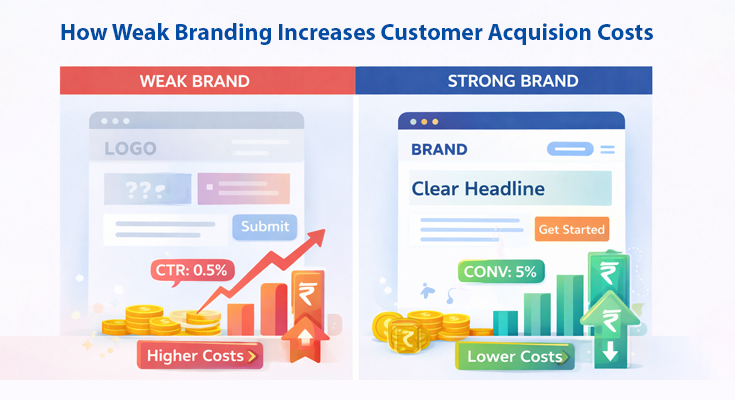
In a competitive digital landscape, businesses often focus heavily on advertising, lead generation, and performance marketing. Yet many founders and marketers overlook a critical factor that quietly drives costs higher: weak branding. When branding lacks clarity, consistency, or trust, customer acquisition becomes more expensive and less sustainable.
This blog explains how weak branding increases customer acquisition costs, why brand trust is central to marketing efficiency, and how a strong branding strategy can reduce dependency on paid advertising.
What Branding Means Beyond Logos and Colors
Branding is far more than a logo or visual style. It is the overall perception people form about your business through every interaction. Effective branding includes brand positioning, messaging, tone of voice, customer experience, and consistency across platforms.
When branding is weak or unclear, customers struggle to understand who you are and why they should trust you. This confusion increases hesitation, slows decision-making, and directly raises acquisition costs.
Businesses working with a strategic branding company in Pune often discover that improving clarity and positioning alone can significantly improve marketing efficiency.
Brand Trust and Customer Acquisition Costs
Customer acquisition costs rise when trust is low. Without trust, prospects take longer to convert, compare more options, and require repeated exposure through ads or follow-ups.
Strong brand trust reduces friction. When customers recognize and trust a brand, they convert faster, require fewer touchpoints, and are more likely to return or recommend the business. This shortens the sales cycle and reduces the overall cost required to acquire each new customer.
Trust is not built through advertising alone. It is built through consistent brand identity, messaging, and positioning.
How Weak Branding Drives Higher Marketing Costs
Increased Ad Spend
Weak branding forces businesses to rely heavily on paid ads to build credibility. Campaigns must run more frequently and for longer durations to compensate for low brand recognition, increasing overall marketing spend.
Lower Conversion Rates
Inconsistent messaging, generic visuals, and unclear positioning lead to lower engagement and weaker conversion performance across websites and campaigns. Even small declines in conversion rates can significantly increase cost per acquisition.
Poor Customer Loyalty
Without emotional connection or differentiation, customers are less likely to return or refer others. This creates a cycle where businesses must constantly invest in acquiring new customers instead of benefiting from repeat business and referrals.
Weak Branding vs Strong Branding in Practice
A business with weak branding may attract clicks through ads but lose customers due to lack of trust or clarity. Visitors hesitate, compare competitors, and leave, forcing repeated retargeting and higher acquisition spending.
In contrast, a business with strong digital branding and clear brand positioning builds instant credibility.
Customers understand the value proposition, feel confident in their decision, and convert more efficiently. Over time, this lowers acquisition costs and improves marketing ROI.
The Psychological Impact of Branding on Decisions
Branding influences decisions at a subconscious level. Familiarity creates comfort, consistency signals reliability, and clear messaging reduces cognitive effort.
Strong brands feel credible and predictable. Weak branding introduces uncertainty, and uncertainty increases resistance. When customers feel unsure, businesses must invest more effort and budget to persuade them, increasing overall marketing costs.
This is why experienced advertising agencies in Pune, India prioritize strategic brand development before scaling performance campaigns.
How Strong Branding Reduces Dependency on Paid Advertising
Brands with strong positioning and consistent identity benefit from higher organic visibility, stronger engagement, and increased referrals. Paid advertising becomes a supporting growth channel rather than the primary driver.
Over time, improved brand equity enhances conversion efficiency, strengthens retention, and improves long-term profitability.
Branding Elements That Help Lower Acquisition Costs
Key elements that reduce customer acquisition costs include:
- A professional and consistent visual identity
- Clear, customer-focused messaging
- Strong brand positioning and differentiation
- Alignment between website, advertising, and communication
- Strategic brand development built for long-term growth
When these elements work together, every marketing effort becomes more efficient.
Common Branding Mistakes That Increase Costs
Many businesses unknowingly increase acquisition costs by:
- Treating branding as a one-time design task
- Copying competitor positioning
- Frequently changing visuals or messaging
- Prioritizing short-term campaigns over long-term brand equity
These mistakes dilute trust and reduce marketing efficiency over time.
Conclusion
Weak branding silently increases customer acquisition costs by lowering trust, reducing conversions, and increasing reliance on paid ads. Strong branding does the opposite. It builds credibility, improves marketing efficiency, and supports sustainable growth.
At Kaizen 360 Branding Pvt. Ltd., we approach branding as a strategic growth foundation. Through structured brand positioning, identity development, and long-term brand strategy, we help businesses reduce marketing inefficiencies and build a brand that supports scalable, sustainable growth.