How UI and UX Work Together in High-Performing Websites
Nov 11, 2025 — Web Design & Development
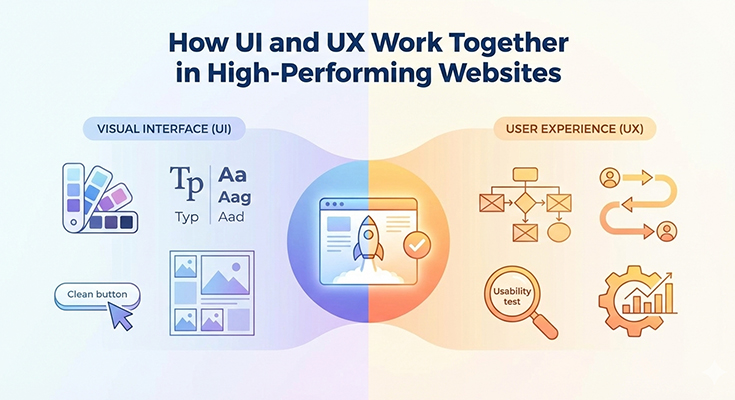
In today’s competitive digital landscape, a website’s success depends on more than visual appeal alone. High-performing websites are the result of a strategic balance between User Interface (UI) and User Experience (UX). While these terms are often used interchangeably, they serve distinct purposes and must work together to deliver meaningful business outcomes.
For businesses investing in professional website design and development, understanding how UI and UX complement each other is essential for creating websites that engage users, build trust, and drive conversions.
Understanding the Difference Between UI and UX
UI and UX play different but interconnected roles in modern website design.
User Interface (UI) focuses on the visual and interactive elements of a website. This includes layout, color schemes, typography, buttons, icons, and overall visual consistency.
User Experience (UX) focuses on how visitors engage with and navigate a website. It covers usability, navigation flow, accessibility, responsiveness, and how easily users can achieve their goals.
A visually appealing interface with poor usability can frustrate users. Similarly, a highly functional website with weak visual design may fail to create a strong brand impression. Successful website design and development requires both UI and UX to work together seamlessly.
Why UI and UX Must Work Together
UI and UX are not independent stages of website creation. They are deeply interconnected and directly influence website performance.
When UI and UX are aligned:
- Users can easily navigate the website and take the intended actions.
- Navigation feels intuitive and effortless
- Visual elements enhance usability instead of drawing attention away from it.
- The website naturally guides users toward conversions
This alignment is a foundational principle of conversion-focused website design.
UI Enhances UX Through Visual Clarity
UI design plays a critical role in improving usability and clarity. Strong visual hierarchy helps users scan content efficiently and prioritize actions.
Effective UI design supports UX by:
- Using consistent typography and spacing for better readability
- Highlighting calls to action clearly
- Maintaining design consistency across pages
- Reducing cognitive load through clean layouts
These elements contribute directly to better user experience optimization and engagement.
UX Gives Purpose to UI Design Decisions
UX strategy informs every UI decision. Without UX research, UI design becomes purely aesthetic and disconnected from user intent.
UX planning supports UI by:
- Identifying user goals and expectations
- Mapping user journeys and interaction paths
- Reducing friction points across the website
- Defining clear conversion flows
In professional website design and development, UX insights guide UI execution to ensure the website performs effectively.
How UI and UX Influence Overall Website Performance
High-performing websites are measured by engagement, retention, and conversion rates. UI and UX directly influence all three metrics.
When UI and UX work together:
- Bounce rates decrease
- Time spent on the website increases
- Conversion paths become clearer
- Users gain confidence in the brand
This is why high-performing websites rely on integrated UI and UX rather than treating them as separate components.
Mobile Experience Depends on UI and UX Alignment
With mobile-first browsing dominating user behavior, UI and UX alignment is even more critical.
Effective mobile-friendly websites require:
- Touch-optimized UI elements
- Readable typography across devices
- Simplified navigation structures
- Responsive and fast-loading layouts
Mobile usability is a key outcome of thoughtful website design and development combined with UX planning.
UI and UX Build Trust and Credibility
Trust is influenced by how intuitive and professional a website feels. Poor navigation, inconsistent visuals, or confusing layouts quickly reduce credibility.
Strong UI and UX help:
- Establish professionalism and reliability
- Create predictable interactions
- Minimize user frustration
- Encourage form submissions and inquiries
This trust directly supports better conversions and long-term business growth.
Common Mistake: Prioritizing UI Over UX
A common mistake is focusing heavily on visuals while neglecting usability. Attractive design alone cannot compensate for a confusing user journey.
High-performing websites avoid this by:
- Balancing aesthetics with functionality
- Testing usability during development
- Continuously improving UX based on user behavior
This balanced approach defines strategic website design and development services.
Conclusion: UI and UX Together Drive Website Success
UI and UX are complementary forces that shape how a website performs. UI captures attention visually, while UX ensures users stay, engage, and convert.
For businesses aiming for sustainable digital growth, investing in website design and development that integrates UI and UX results in websites that are visually refined, user-friendly, and performance-driven.