Future-Proofing Your Website: Design Trends That Will Still Matter in 2030
Dec 02, 2025 — Web Design & Development
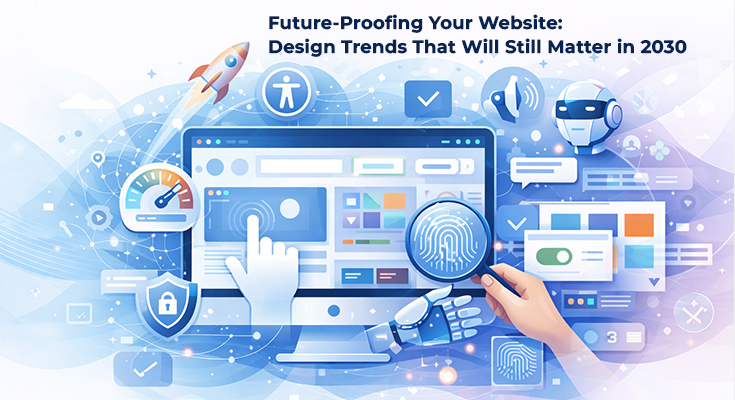
Website design trends come and go, but some foundational shifts driven by technology and user behavior will continue to define effective digital experiences through 2030. Future-proofing your website means investing in these enduring principles that prioritize speed, accessibility, user control, and semantic clarity, all of which are core to professional website design and development.
The Enduring Pillars of UX and Performance
These are the non-negotiable foundations that determine whether a site is usable and trustworthy in the long run, especially for businesses investing in long-term website development services.
1. Radical Performance (Speed Is Non-Negotiable)
Speed is the ultimate user experience feature. As global internet access improves and user patience decreases, Core Web Vitals metrics will only become more stringent and critical for search ranking and conversion in modern website design and development.
Focus:
Websites must achieve near-instantaneous load times. This means prioritizing minimalist code, highly optimized images and video assets, and server-side rendering or progressive web application architecture as part of performance-focused website development.
Trend in 2030:
Expect near-zero Largest Contentful Paint times, driven by smarter caching and edge computing.
2. Universal Accessibility (A Foundation, Not a Feature)
Designing for accessibility is no longer a niche requirement but a legal and ethical mandate that dramatically expands your audience. As AI tools increasingly interact with web content, well-structured and accessible websites are easier for these tools to interpret, making accessibility essential in website design services.
Focus:
Strict adherence to WCAG guidelines. This includes high color contrast, keyboard navigation, clear ARIA labels, and logical heading structures, all of which should be built into professional website design and development.
Trend in 2030:
Personalized accessibility where websites automatically adjust contrast, font size, or navigation based on user settings.
3. Semantic and Structural Clarity
Search engines and generative AI models rely on understanding the structure and meaning of content. A visually stunning but semantically confusing site will be ignored, regardless of how modern the website design appears.
Focus:
Meticulous use of semantic HTML elements, consistent heading hierarchy, and structured data markup to support SEO-ready website development.
Trend in 2030:
AI-optimized content where site structure is designed not just for rankings, but for accurate AI interpretation and citation.
Immersive and Interactive Design Trends
The way users interact with the interface will become more flexible, conversational, and intuitive in future-ready website design and development.
4. Modular and Adaptive Design Systems
Static page templates are restrictive. Websites must be built from reusable components that can adapt across devices and platforms, which is a core principle of scalable website development.
Focus:
Using structured design systems and modern CSS frameworks to create flexible, responsive components.
Trend in 2030:
Dynamic theming where layouts and color schemes adapt based on user context or device type.
5. Conversational and Voice User Interfaces
As voice technology matures, websites must accommodate conversational inputs beyond traditional navigation, influencing both UX and website development strategy.
Focus:
Integrating AI chat interfaces and designing layouts that support natural language interactions.
Trend in 2030:
Invisible interfaces where predictive AI handles tasks with minimal user input.
6. Data Transparency and User Control Interfaces
Following global privacy mandates, users expect clear control over their data and website experience, making transparency a key part of trust-focused website design and development.
Focus:
Developing intuitive privacy dashboards and consent management tools that are easy to understand and manage.
Trend in 2030:
Decentralized identity integration allowing users to manage credentials and permissions independently.
Aesthetic and Emotional Shifts
While visual styles change, authenticity and usability remain central to effective website design.
7. Authentic and Human-Centered Imagery
Generic stock visuals are losing relevance as users prefer authentic representation.
Focus:
Original photography and videography featuring real people and environments, aligned with brand identity in professional website design services.
Trend in 2030:
Contextual AI-generated visuals that support personalization while maintaining brand authenticity.
8. Focused Minimalism and Content Utility
Cluttered interfaces reduce clarity and engagement.
Focus:
Intentional layouts, strong typography, and content that serves a clear purpose within conversion-focused website design and development.
Trend in 2030:
Adaptive content delivery that shows only what users need to achieve their immediate goal.
Conclusion
By prioritizing these enduring principles, from performance and accessibility to semantic clarity and authenticity, your website will be well-equipped to remain relevant, trustworthy, and effective through 2030. Businesses that invest in strategic website design and development today build digital assets that continue to perform as technology, user behavior, and search environments evolve.
At Kaizen 360 Branding Pvt. Ltd., we help businesses create impactful digital strategies through branding, SEO, ASO, PPC, web design and development, graphic design, logo design, social media marketing, content writing and marketing, and corporate videos.
Want to build a purpose driven brand that stands out in any situation? Let us help you create a strategy that delivers real value and long term growth.