Digital Marketing Trends for 2026: Strategies Businesses Need to Know
Sep 07, 2026 — Digital Marketing
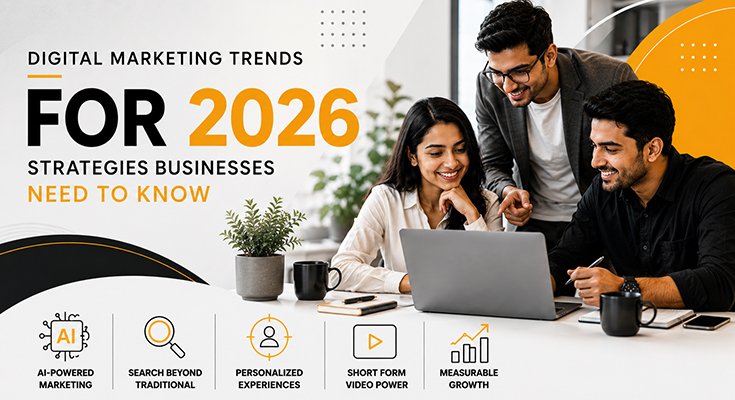
Digital marketing in 2026 is becoming more intelligent, personalized, conversational, and measurable. Customers are no longer discovering businesses through only traditional search engines or advertisements. They are using AI platforms, social media, short form videos, websites, messaging apps, reviews, and online communities throughout their buying journey.
For businesses, this means having a digital presence is no longer enough. Marketing strategies need to connect different channels, deliver useful experiences, and respond to changing customer behavior.
The most successful businesses in 2026 will not necessarily be those using the most marketing tools. They will be the ones that combine technology with clear strategy, useful content, strong creative execution, and consistent measurement.
Here are the key digital marketing trends businesses should understand in 2026.
1. Artificial Intelligence Will Become a Core Marketing Tool
Artificial intelligence is moving beyond basic content generation. Businesses are increasingly using AI for audience research, content planning, personalization, campaign analysis, automation, customer support, and creative development.
AI can help marketing teams identify patterns in customer behavior, generate content variations, analyze campaign performance, and automate repetitive activities.
However, successful AI marketing still requires human oversight.
Businesses need marketers to define brand voice, understand customer expectations, review content, make strategic decisions, and ensure communication remains authentic.
The goal should not be to replace marketers with AI. It should be to use AI to make marketing teams more efficient while allowing people to focus on strategy, creativity, and customer relationships.
2. Search Is Expanding Beyond Traditional Search Engines
Search behavior is changing rapidly.
Customers can now ask detailed questions through AI powered search platforms and receive direct answers instead of simply browsing a list of websites.
This creates a new opportunity for businesses to improve how their content is discovered and understood.
Digital marketers should focus on:
- Search Engine Optimization
- Answer Engine Optimization
- Generative Engine Optimization
- Helpful educational content
- Topical authority
- Clear service information
- Well structured website content
Traditional SEO remains important, but businesses should also consider how their content can provide useful answers across modern search experiences.
3. Personalization Will Become More Important
Customers increasingly expect brands to understand their needs instead of showing everyone the same message.
Personalization can be used across:
- Email campaigns
- Website experiences
- Advertisements
- Landing pages
- Social media content
- Product recommendations
- Customer communication
Effective personalization goes beyond adding a customer’s name to an email. Businesses can use customer behavior, interests, previous interactions, location, and buying stage to make communication more relevant.
The challenge is maintaining a balance between personalization and privacy. Businesses should collect and use customer information responsibly while providing genuine value in return.
4. Short Form Video Will Continue Driving Discovery
Short form video remains one of the most effective ways to capture attention online.
Instagram Reels, YouTube Shorts, and other short video formats allow businesses to communicate ideas quickly while showing their products, people, expertise, and brand personality.
Businesses can use short form videos for:
- Product demonstrations
- Customer testimonials
- Educational tips
- Behind the scenes content
- Founder videos
- Frequently asked questions
- Industry insights
- Product comparisons
However, simply producing more videos will not guarantee better results.
Every video should have a clear purpose. It should educate, entertain, solve a problem, answer a question, or give the audience a reason to remember the brand.
5. Social Media Will Become More Search Focused
Social media is increasingly becoming a discovery channel.
People search platforms such as Instagram, YouTube, and LinkedIn for businesses, recommendations, educational content, products, reviews, and industry information.
This means businesses should think about discoverability when creating social content.
Clear captions, relevant keywords, descriptive profiles, useful video titles, and educational content can help users understand what a business offers.
Social media should therefore be treated as part of the wider search journey rather than simply a place to publish posts.
6. First Party Data Will Become More Valuable
Customer data is becoming increasingly important as businesses face greater privacy expectations and changes in digital tracking.
First party data can include:
- Website enquiries
- Email subscribers
- CRM records
- Customer purchases
- Form submissions
- WhatsApp conversations
- Loyalty program information
The value of first party data comes from how responsibly and effectively it is used.
Businesses can use this information to understand customer needs, improve personalization, create relevant campaigns, and measure customer journeys.
Instead of collecting large amounts of information without a clear purpose, businesses should focus on collecting useful data with transparency and customer consent.
7. Conversational Marketing Will Continue Growing
Customers increasingly expect businesses to respond quickly and communicate through convenient channels.
Website chat, WhatsApp, social media messaging, email, and other conversational channels can help businesses answer questions, qualify leads, provide support, and guide customers toward the next step.
This is particularly valuable for businesses where customers need information before making a purchase decision.
Automation can handle repetitive questions and initial responses, while human support can take over when the conversation requires judgment or detailed assistance.
The future of customer communication is moving from one way messaging toward more responsive and personalized conversations.
8. Content Quality Will Matter More Than Content Volume
AI has made content production faster. This also means the internet is becoming increasingly crowded with similar and repetitive content.
Publishing more articles does not automatically create better visibility.
Businesses need content that offers genuine value through:
- Original insights
- Case studies
- Expert opinions
- Practical guides
- Customer stories
- Industry analysis
- Detailed explanations
- Answers to real customer questions
Strong content should demonstrate experience and provide information that readers can actually use.
A smaller collection of useful and original resources can be more valuable than a large library of repetitive articles.
9. Marketing Automation Will Improve Efficiency
Automation is becoming an important part of modern digital marketing.
Businesses can automate:
- Lead follow ups
- Email sequences
- Customer reminders
- Reporting
- Audience segmentation
- Appointment communication
- Lead qualification
- Campaign workflows
Automation can reduce repetitive work and allow marketing teams to focus more on strategy and creative development.
However, automation should not make communication feel robotic.
Businesses should identify which interactions can be automated and which situations require personal attention. The best automation strategies combine efficiency with a human customer experience.
10. Marketing Measurement Will Focus More on Business Results
Likes, impressions, followers, and website traffic can provide useful information, but they do not always explain whether marketing is actually generating business.
In 2026, businesses should place greater emphasis on measurable outcomes.
Important metrics include:
- Qualified leads
- Cost per lead
- Conversion rate
- Customer acquisition cost
- Return on advertising spend
- Organic enquiries
- Revenue generated
- Customer retention
- Lead to customer conversion
A campaign that generates fewer clicks can still outperform a high traffic campaign if it produces better quality leads and more revenue.
Marketing teams therefore need to connect campaign data with actual business objectives.
How Businesses Should Respond to These Trends
Businesses do not need to adopt every new marketing trend immediately.
The right strategy depends on the target audience, industry, business model, budget, and growth objectives.
A B2B company may prioritize SEO, AI search visibility, LinkedIn content, thought leadership, lead generation, and email marketing.
An ecommerce business may focus more on short form video, personalization, social commerce, customer data, and remarketing.
A local business may prioritize local SEO, Google Business Profile optimization, reviews, social media discovery, and conversion focused website improvements.
The important thing is to start with customer needs rather than technology.
Digital Marketing Checklist for 2026
Before planning your next marketing campaign, ask:
- Is our website optimized for search and AI discovery?
- Are we creating useful content around real customer questions?
- Are we using AI responsibly to improve marketing efficiency?
- Are our social media channels helping people discover our business?
- Are we using short form video effectively?
- Are we collecting and managing first party data responsibly?
- Can customers easily contact us through messaging channels?
- Are our marketing activities connected to measurable business goals?
- Are we regularly reviewing campaign performance?
- Is our brand experience consistent across digital channels?
Frequently Asked Questions
What are the biggest digital marketing trends for 2026?
The major trends include artificial intelligence, AI search visibility, personalization, short form video, social search, first party data, conversational marketing, content quality, automation, and stronger performance measurement.
Will AI replace digital marketers?
AI will automate many repetitive marketing activities, but strategy, creativity, brand understanding, customer relationships, and decision making still require human judgment.
Is SEO still important in 2026?
Yes. SEO remains an important part of digital visibility while expanding into newer search experiences involving AI platforms and conversational discovery.
Why is first party data important?
First party data helps businesses understand their customers through information collected directly from their own interactions. When handled responsibly, it can improve personalization, customer communication, and marketing measurement.
Should every business invest in short form video?
Not necessarily at the same level. Businesses should identify where their target audience spends time and select content formats that support their specific marketing objectives.
Why Choose Kaizen 360 Branding Pvt. Ltd.?
At Kaizen 360 Branding Pvt. Ltd., we help businesses develop integrated digital marketing strategies focused on visibility, engagement, lead generation, and measurable growth.
Our services include:
- Search Engine Optimization
- Digital Marketing
- Social Media Marketing
- Website Design and Development
- Content Marketing
- Performance Marketing
- Lead Generation
- Google Business Profile Optimization
- Branding and Creative Design
By combining strategy, content, creative execution, search optimization, paid campaigns, and performance analysis, we help businesses build stronger digital presence and create meaningful connections with their target audiences.
Conclusion
Digital marketing in 2026 is becoming more intelligent, personalized, conversational, and measurable.
Artificial intelligence is changing how marketing teams work. Search is changing how customers discover information. Short form video is changing how brands capture attention. First party data is becoming more valuable, while automation is helping businesses manage repetitive marketing activities more efficiently.
But technology alone will not create successful marketing.
Businesses still need clear positioning, useful content, strong creative ideas, authentic communication, and a strategy built around customer needs.
The businesses that succeed in 2026 will be those that adopt new technology without losing the human side of marketing.
The goal is not to follow every trend. It is to identify the changes that matter to your customers and turn them into a practical digital marketing strategy that supports long term business growth.
At Kaizen 360 Branding Pvt. Ltd., we help businesses create impactful digital strategies through branding, SEO, ASO, PPC, web design and development, graphic design, logo design, social media marketing, content writing and marketing, and corporate videos.
Want to build a purpose driven brand that stands out in any situation? Let us help you create a strategy that delivers real value and long term growth.