Beyond Rankings: How Meta Titles, Meta Descriptions, and Headers Influence SEO Performance
Jul 06, 2026 — SEO
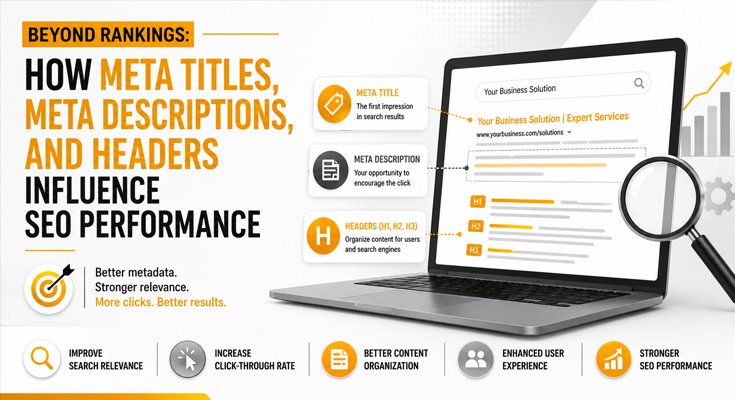
When businesses think about improving their search visibility, they often focus on keywords, backlinks, or content creation. While these elements remain important, several smaller on-page SEO components quietly influence how search engines understand web pages and how users interact with search results.
Meta titles, meta descriptions, and heading tags may seem like technical details, but they contribute to website visibility, content organization, and user engagement. When optimized correctly, they help search engines interpret page content while encouraging users to click through from search results.
Understanding how these elements work together can strengthen a website’s overall SEO performance.
Why Do Meta Titles Matter?
A meta title is usually the first piece of information users notice when a webpage appears in search results. It gives both search engines and potential visitors an overview of what the page is about.
A well-written meta title helps:
- Describe page content clearly
- Improve search relevance
- Increase click-through opportunities
- Support keyword targeting
- Differentiate pages within a website
Instead of simply adding keywords, businesses should create titles that accurately reflect the page while matching the user’s search intent.
How Meta Descriptions Influence User Decisions
Although meta descriptions are not considered a direct ranking factor, they often influence whether someone chooses to visit a webpage.
A strong meta description should:
- Summarize the page naturally
- Highlight the value users will receive
- Encourage informed clicks
- Match the content available on the page
When descriptions accurately represent the page, users are more likely to have positive experiences after visiting the website.
Why Heading Structure Matters for SEO
Headings organize content into logical sections, making information easier to understand for both visitors and search technologies.
A clear heading hierarchy typically includes:
- One H1 that introduces the primary topic
- H2 headings for major sections
- H3 headings for supporting information
Well-structured headings improve readability while helping search engines recognize the relationship between different sections of content.
How These Elements Work Together
Meta titles, descriptions, and headings should not be treated as separate SEO tasks.
Together they help create consistency between:
- Search results
- User expectations
- Website content
When users click a search result and immediately find content that matches the title and description, they are more likely to remain engaged and continue exploring the website.
Why Search Intent Should Guide Metadata
Effective metadata begins with understanding what users are trying to find.
Instead of writing titles only for search engines, businesses should consider:
- What question is the user asking?
- What solution are they expecting?
- Does the page answer that expectation?
Aligning metadata with search intent creates a better experience for both users and search platforms.
The Growing Importance of Metadata in AI Search
Modern search experiences continue to evolve with AI-powered technologies.
While artificial intelligence can interpret webpage content in more advanced ways, structured metadata and logical headings still provide valuable context that helps systems understand page topics more efficiently.
Well-organized pages also improve consistency between traditional search results and emerging AI-powered search experiences.
Common Metadata Mistakes Businesses Make
Many websites reduce their SEO potential because of avoidable mistakes such as:
- Duplicate meta titles
- Missing meta descriptions
- Generic page titles
- Multiple H1 headings on a single page
- Headings used only for visual styling
- Metadata that does not match page content
Addressing these issues can improve website quality and strengthen overall search performance.
Best Practices for Optimizing Metadata
Businesses should regularly review their website to ensure every important page includes:
- A unique meta title
- A relevant meta description
- One descriptive H1 heading
- Logical H2 and H3 sections
- Metadata that reflects actual page content
- Keywords used naturally within titles and headings
These improvements contribute to a stronger foundation for long-term Search Engine Optimization.
Why Metadata Supports Better User Experience
Good metadata is not only about search engines.
It helps users understand what they can expect before visiting a page, making search results more informative and reducing confusion.
Similarly, organized headings allow visitors to navigate content more easily, especially when reading longer articles or service pages.
Clear communication often leads to stronger engagement and improved website usability.
Conclusion
Successful SEO is built through many interconnected elements, and metadata remains one of the most important foundations of on-page optimization. Well-crafted meta titles, meta descriptions, and heading structures improve content organization, strengthen search relevance, and create better experiences for users.
As search technology continues to evolve, businesses that invest in structured, user-focused website optimization will be better positioned to improve visibility across both traditional search engines and AI-driven search experiences.
At Kaizen 360 Branding Pvt. Ltd., we help businesses improve website performance through strategic Search Engine Optimization, content optimization, and technical SEO practices that strengthen online visibility and support long-term digital growth.
Frequently Asked Questions (FAQs)
Why are meta titles important for SEO?
Meta titles help search engines understand the primary topic of a webpage while providing users with a clear overview before they click a search result.
Do meta descriptions improve search rankings?
Meta descriptions are not a direct ranking factor, but they can influence click-through rates by giving users a concise summary of the page.
Why should every webpage have only one H1 heading?
A single H1 helps establish the primary topic of the page and creates a clear content hierarchy for both users and search technologies.
How often should businesses review their website metadata?
Metadata should be reviewed whenever pages are updated, new content is published, or SEO improvements are being implemented.
Can optimized headings improve user experience?
Yes. Clear heading structures make content easier to read, navigate, and understand, especially on longer webpages and blog articles.
At Kaizen 360 Branding Pvt. Ltd., we help businesses create impactful digital strategies through branding, SEO, ASO, PPC, web design and development, graphic design, logo design, social media marketing, content writing and marketing, and corporate videos.
Want to build a purpose driven brand that stands out in any situation? Let us help you create a strategy that delivers real value and long term growth.